
If you’ve asked “how do I spot a new domain registration trend before it explodes,” start with a fact worth accepting: every trend tool is lagging. Data has to happen before it can be measured. So the question isn’t which tool gets there first. It’s whether the signal you’re looking at is real.
Two keywords can sit next to each other on the same chart with the same numbers. One is a thousand independent registrants chasing the same idea. The other is one company running a script. The list looks identical. The reality is opposite.
This post is about the test we apply to tell them apart.
The problem with count alone
Count is useful because it tells you where activity is happening. But count alone cannot tell you who is behind that activity, whether it came from many independent registrants, or whether it came from one coordinated source.
That’s why no single bar proves a registration trend is real or fake. The signal lives in how multiple bars line up together.
What a real registration trend looks like
A real registration trend has multiple parties acting on their own initiative.
New registrations are not the whole domain market, but they are one of the clearest public traces of what people are starting to care about. When demand for “AI agents” is real, you see startup founders registering domains to build products. You see investors registering to flip later. You see brand teams registering to defend trademarks. You see speculators registering on the chance someone else will want them. None of them coordinated. None of them know each other. They all show up because the keyword genuinely matters to the market.
When a keyword is one operator instead of a market signal, you see one of those parties show up alone. One company registering 800 names in a week. One registrar handling almost all of them. One nameserver pointing the entire batch at the same place. That may still be interesting, but it is more likely to be a concentrated bet than broad market consensus.
The distinction matters because one of these is registration momentum you can study, and the other is noise dressed up as a trend.
The independence test
We built our keyword trends page around a single principle:
In newly registered domains, a keyword becomes meaningful when multiple market participants act on it independently.
To make that visible, we show three things for every keyword instead of one:
TLD distribution. What share went to .com versus everything else. .com is the most liquid domain market, so the split tells you something about how participants are choosing to spend. It’s a data point, not a verdict. Read it together with the other bars.
Nameserver distribution. Where the domains are pointed. We split this into three buckets: Active DNS (Cloudflare, AWS, Vercel, Netlify) for domains likely being used, For Sale (Sedo, Afternic, Atom, 4cn) for domains listed on marketplaces, and Others for everything else. A keyword with all three present looks more like a market. A keyword concentrated entirely in one bucket looks more like one operator. But again, one bar alone doesn’t decide it.
Time distribution. When the registrations happened. Last 48 hours, two to seven days ago, eight to thirty days ago. A real trend usually builds over weeks. A scripted run tends to finish quickly. Tendencies, not rules.
Each of these views, on its own, can be misread. Together, they’re harder to fake. An operator can buy 800 .coms, but they can’t easily simulate the messy distribution of independent buyers across registrars, nameservers, and weeks all at once.
How to use the page
Open the Hot tab first. Start with the top few keywords there as your registration baseline. At the time of writing, keywords like ai, my, hub, group, and pro showed what a healthy, sustained, multi-party registration pattern tends to look like across all three bars at once: a meaningful TLD mix, a meaningful slice of Active DNS alongside For Sale and Others, and registrations spread across the four weeks rather than piled into one.
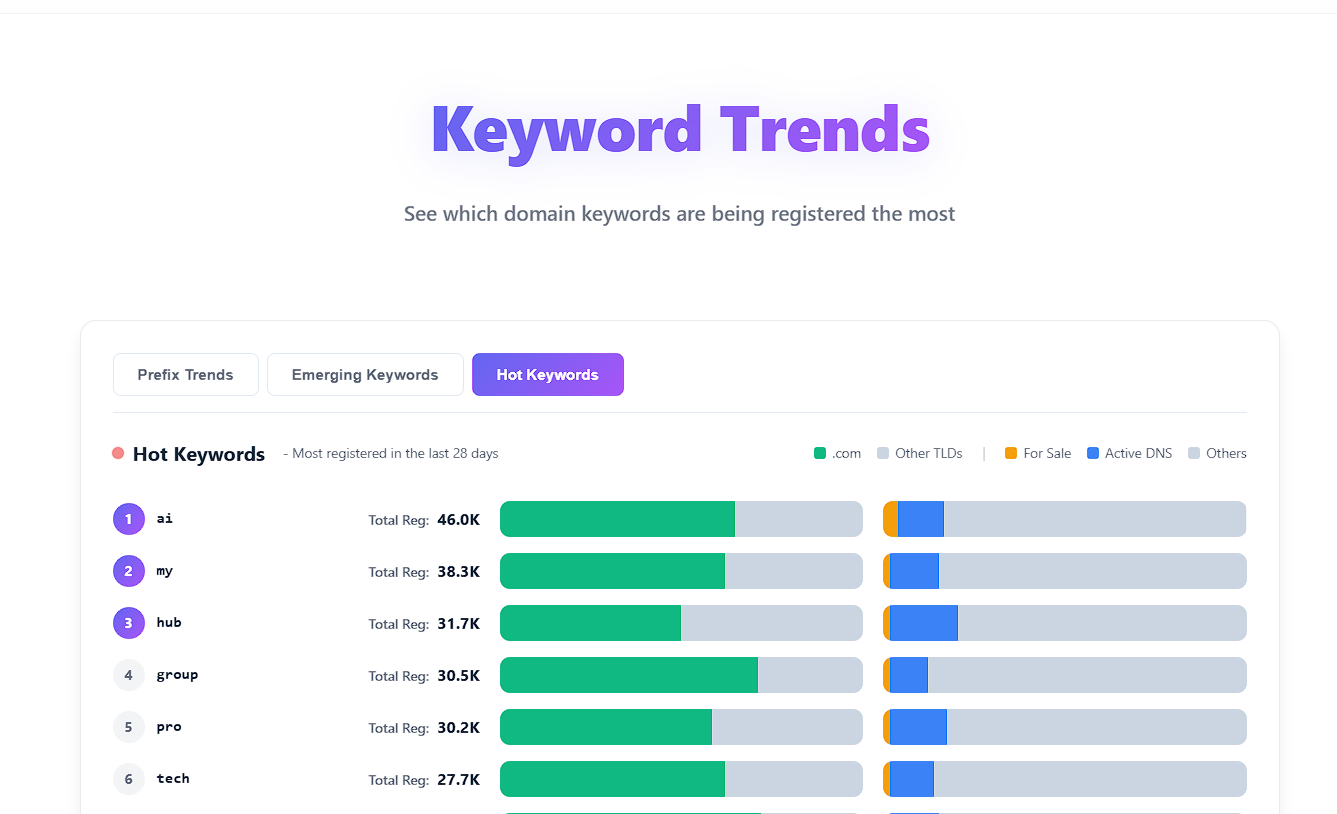
That combined shape is what a real registration trend looks like. Not any single bar in isolation, but the way the bars line up together.
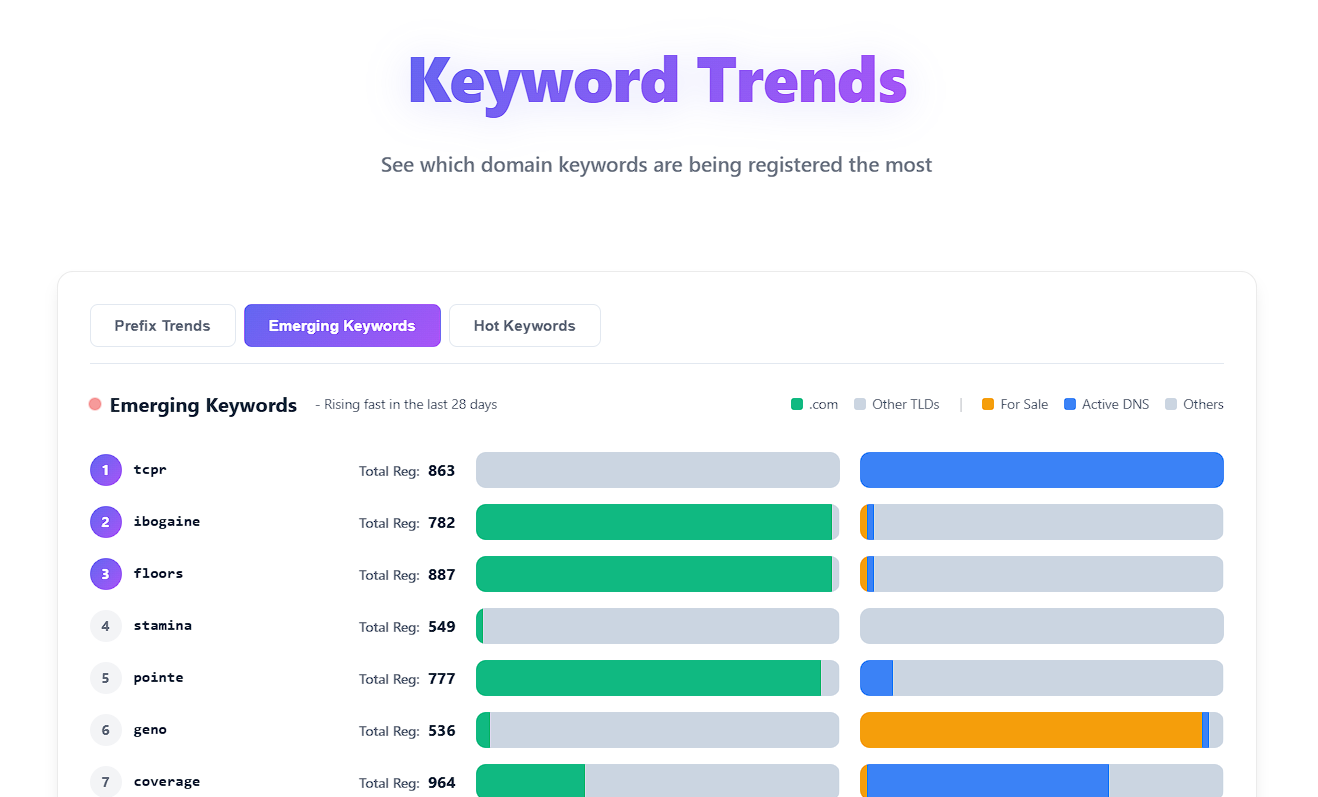
Now switch to the Emerging tab. Compare each row to that combined shape. Rows that look broadly like the baseline, with a similar mix across all three bars but newer activity, are more likely to be real emerging registration trends. Rows that diverge across multiple bars at once, with concentrated TLDs, concentrated nameservers, and concentrated timing, are more likely to be one operator. The point isn’t any single bar saying so. It’s the bars agreeing.
The Prefix tab works the same way for naming patterns instead of words. The time bar tells you whether the prefix is gaining momentum or whether yesterday’s spike was a one-off, but always read it alongside the rest.
What we don’t tell you
We don’t label keywords as “good” or “bad.” We don’t put red warning badges on suspicious rows. We don’t tell you what to register.
That’s deliberate. The page is not a recommendation engine. It is a market-reading tool for newly registered domain activity.
The same keyword that looks like a single-operator burst to an investor might be exactly what a brand protection team is looking for. Same data, different reader, different conclusion. Our job is to put the facts on the page accurately. Your job is to read them.
What’s not in the data
The numbers you see are not every domain registered with that keyword. We process the raw stream first. We segment domain names into actual words, so abtdomain.com becomes abt and domain, not bt and main. We filter out junk patterns that algorithms generate by the thousand. What’s left is a cleaned, segmented, and filtered sample designed to show the broader direction of new registration activity.
It points you to the broader direction of the market through newly registered domains. It does not pretend to be the whole market. Trust it for shape and signal, not for exact counts.
The one-line version
If you remember one thing from this post, remember this:
Count tells you what’s loud. Independence tells you what’s real. The bars show you the difference.
Then go open domainkits.com/trends/keywords and apply the test.