
A trained Qwen3.5-9B reads the record of a domain’s use and returns one of six tags plus three sentences a person can check. On 100 held-out cards it reads at the level of a larger local model and a commercial API that reason before they answer, in about 80 tokens, on a single GPU of your own.
Since From Ford’s Assembly Line to Local AI Pipelines we have stayed with one question: which model can do the work at the right point of the line, at the smallest size and the lowest cost. To get there, we trained a 9B model. Let us start with an old example, cloudebot, and see how the model handles it.
One name, six different uses
We designed one input structure for this central model and call it the domain card. It carries the domain prefix, the brand and its line of business, a line of background on the brand owner, the name relation, the recorded conduct of the site, and four flags: parking, pay-per-click links, sale, phishing. That card is the whole input.
In this example the CLAUDE part of the card stays the same, and we wrote six different scenarios for the domain to test how the model responds. The outputs are the model’s actual answers.
The common part of the card is:
domain prefix: cloudebot
brand: CLAUDE
brand business: AI assistant and large language model services
brand background: Anthropic PBC, founded in 2021, develops the Claude family of
  AI assistants and offers them to consumers and businesses through chat apps
  and an API.
name relation: similar
1. A robotics shop. We describe the site as: Resolves to the online shop of a robotics company selling cloud-connected home and warehouse robots, spare parts and firmware; no reference to AI assistants or to the Complainant. No flags. The Qwen3.5-9B answers:
TAG: own_business
SITE: The domain resolves to the online shop of a robotics company selling
  cloud-connected home and warehouse robots, spare parts and firmware.
MARK: The prefix cloudebot is similar to CLAUDE, but the shop sells robots, not
  AI assistant and large language model services.
SO: The holder runs its own unrelated robotics business, so this is own
  business use.
2. An AI assistant. We describe the site as: Resolves to a website offering an AI chat assistant for customer support, built on third-party language models, with free and paid subscription plans. No flags. The Qwen3.5-9B answers:
TAG: selling_same_line
SITE: The site offers an AI chat assistant for customer support built on
  third-party language models, with free and paid subscription plans.
MARK: The prefix cloudebot is a near copy of CLAUDE plus bot, and the service
  sits in the same AI assistant line.
SO: The holder runs a competing AI chat service under a name that reads as the
  mark, so this is same-line selling.
3. A clone with a login form. We describe the site as: Resolves to a website styled as the official Claude bot, reproducing the Complainant’s logo and product pages and presenting a login form that asks for the user’s Anthropic account e-mail and password. Flag: phishing. The Qwen3.5-9B answers:
TAG: impersonation
SITE: The site is styled as the official Claude bot, reproducing the logo and
  product pages, and collects Anthropic account email and password.
MARK: The prefix cloudebot is a near copy of CLAUDE plus bot, and the page
  presents the same AI assistant service.
SO: Copying the official site and harvesting account credentials is
  impersonation of the rights holder itself.
4. A redirect to a casino. We describe the site as: Redirects to an online casino website offering slot games and sports betting. No flags. The Qwen3.5-9B answers:
TAG: traffic_diversion
SITE: The domain redirects visitors to an online casino website offering slot
  games and sports betting.
MARK: The prefix cloudebot is a near copy of CLAUDE plus bot, while gambling
  has no overlap with AI assistant services.
SO: A mark-like name pushes traffic to unrelated gambling commerce, so this is
  traffic diversion.
5. A parking page with unrelated links. We describe the site as: Resolves to a parking page with pay-per-click links to car insurance quotes and mortgage refinancing offers. Flags: parked, ppc. The Qwen3.5-9B answers:
TAG: parked_sale
SITE: The domain resolves to a parking page carrying pay-per-click links to car
  insurance quotes and mortgage refinancing offers.
MARK: The prefix cloudebot is a near copy of CLAUDE plus bot, while insurance
  and refinancing links miss the AI assistant business.
SO: A passive parking page with links unrelated to the mark trade, so this is
  parked monetization rather than same-line selling.
6. Nothing there. We describe the site as: The domain name does not resolve to an active website. No flags. The Qwen3.5-9B answers:
TAG: blank
SITE: The domain name does not resolve to an active website, and no page
  content or links are recorded.
MARK: The prefix cloudebot is a near copy of CLAUDE plus bot, matching the AI
  assistant business.
SO: With no resolving page and no recorded content, the domain sits blank
  despite the close name match.
From the answers, the trained model tells the six scenarios apart and reads what a use of this name amounts to in each of them: a robotics shop is the holder’s own business, an AI assistant is the brand’s line, a copied login page is impersonation. How does that compare with a commercial API, and what does the comparison tell us?
How it compares
To observe the model’s characteristics more closely, we took 100 independent cases across the six types as test cases, kept completely separate from the training data. During the experiments, the arrival of the new Qwen3.8-27B and DeepSeek V4.1 Flash gave us better reference points.
Local options: the trained 9B, an untrained Qwen3.8-27B, and rules.
| Tag | Number | Trained 9B | 27B v1¹ | 27B v1¹ no thinking |
27B v2² | Rules |
|---|---|---|---|---|---|---|
selling_same_line |
30 | 29 | 29 | 29 | 28 | 12 |
blank |
20 | 20 | 20 | 20 | 18 | 15 |
impersonation |
10 | 9 | 8 | 7 | 9 | 9 |
parked_sale |
20 | 19 | 20 | 16 | 20 | 19 |
traffic_diversion |
11 | 9 | 7 | 8 | 7 | 5 |
own_business |
9 | 8 | 9 | 8 | 8 | 7 |
| Total | 100 | 94 | 93 | 88 | 90 | 67 |
Against a commercial API: DeepSeek V4.1 Flash.
| Tag | Number | Trained 9B | DeepSeek v1¹ | DeepSeek v1¹ no thinking |
DeepSeek v2² |
|---|---|---|---|---|---|
selling_same_line |
30 | 29 | 30 | 28 | 29 |
blank |
20 | 20 | 20 | 20 | 12 |
impersonation |
10 | 9 | 9 | 9 | 9 |
parked_sale |
20 | 19 | 19 | 16 | 17 |
traffic_diversion |
11 | 9 | 10 | 7 | 7 |
own_business |
9 | 8 | 9 | 7 | 9 |
| Total | 100 | 94 | 97 | 87 | 83 |
¹ v1: the prompt with our rulebook in it. ² v2: the 9B’s short prompt (note 2). 27B is Qwen3.8-27B with no training and DeepSeek is DeepSeek V4.1 Flash; their columns ran with thinking on unless marked no thinking. The trained 9B ran with thinking off. The 27B with the short prompt and thinking off, in the training wording of the prompt, scores 87; DeepSeek was not run with the short prompt and thinking off. Rules: the four flags and obvious keywords, no model. The data source is in note 1, the prompts in note 2.
Read as a whole, the table says one thing. The trained 9B, answering without a reasoning passage, lands where the larger untrained local model and the commercial API land only with our rulebook in their prompt and thinking switched on: 94 of 100 against 93 and 97. It handles the large majority of cards, and its misses cluster between neighbouring categories, impersonation against same product and parking against redirect elsewhere, three of the six. This result supports the 9B on a single GPU as a candidate for this station.
The model is built to assist the work and make it faster, not to replace the person doing it. We used 100 cards as the test set in these experiments, and they are not the final word on the model. Let us look at two of its answers.
samsflaminggrill.com (WIPO D2019-2135). The card as the model reads it:
domain prefix: samsflaminggrill
brand: SAM’S FLAMING GRILL
brand business: restaurant services
brand background: Complainant operates numerous Mediterranean restaurants,
  predominantly or exclusively in California.
name relation: contains
site conduct: Resolves to a largely undeveloped parking page with hyperlinks to
  topics such as 'takeout menu', 'menu restaurant', 'delivery restaurant', and
  links to competitor restaurants. || resolves_to: Parking page with
  pay-per-click links
flags: parked=True ppc=True for_sale=False phishing=False
Characterize the use of this domain.
The Qwen3.5-9B answers:
TAG: selling_same_line
SITE: The domain resolves to a parking page with pay-per-click links to takeout
  menu, restaurant menu, delivery restaurant, and competitor restaurants.
MARK: The prefix reproduces the SAMS FLAMING GRILL mark, and the linked
  restaurant and delivery topics match its restaurant services.
SO: The parking links bite directly into the restaurant trade, so the page
  monetizes the mark by promoting same-line services.
Every field says parking: parked and ppc are set, and the record ends in “parking page with pay-per-click links”, so a rule over the flags stops there and says parking. The answer is same product because the links are takeout menus, delivery and competitor restaurants, the mark owner’s own trade, and that comparison sits in no field. The model’s first sentence lists the link topics and its second ties them to restaurant services, so a reviewer can check the reading against the card; the same-product route then asks for captures of those links.
A note on the input. The card carries several fields on purpose: the brand, its line of business, the name relation, the recorded conduct and the flags are there to guide a small model to an accurate reading. They do not make the reading mechanical. Deciding that takeout menus and delivery restaurants belong to a restaurant’s line of business takes knowledge of the trade, and a rule cannot hold that knowledge in advance for every industry. That is what the training is for: the rules of the trades are countless and cannot be written out one by one; the training examples teach the model the comparison itself.
projectnarcan.shop (Forum FA2412002129972). The card as the model reads it:
domain prefix: projectnarcan
brand: NARCAN
brand business: biopharmaceutical
brand background: Complainant is a specialty biopharmaceutical company
  established 25 years ago, manufacturing and delivering specialty products that
  address public health threats through innovative vaccines and therapeutics. It
  uses the NARCAN mark for its NARCAN Nasal Spray, a naloxone nasal spray
  product.
name relation: contains
site conduct: Resolves to a website offering T-shirts for sale bearing the word
  'NARCAN' within a graphic design. || resolves_to: Website selling T-shirts
  with NARCAN graphic
flags: parked=False ppc=False for_sale=False phishing=False
Characterize the use of this domain.
The Qwen3.5-9B answers:
TAG: selling_same_line
SITE: The site sells T-shirts bearing the word NARCAN inside a graphic design.
MARK: The prefix contains the NARCAN mark, and the shirts trade on that
  biopharmaceutical product name.
SO: Selling merchandise under the mark name is same-line commercial use of the
  mark.
Under the rulebook this is own business: the name itself runs a shop, and T-shirts are not the biopharmaceutical line the mark covers. The model said same product. In a follow-up controlled test, T-shirts carrying the brand word were classified as same product every time, for a real brand and an invented one alike, while plain T-shirts were separated correctly into own business and same product. The tag is wrong, but the explanation keeps the key fact, that the goods are T-shirts, so a reviewer can check the classification against the rules.
The tokens
On tag accuracy the 9B holds its own on these 100 cards. The tokens tell a more interesting story: here the 9B is clearly ahead, and that is the specialised training at work.
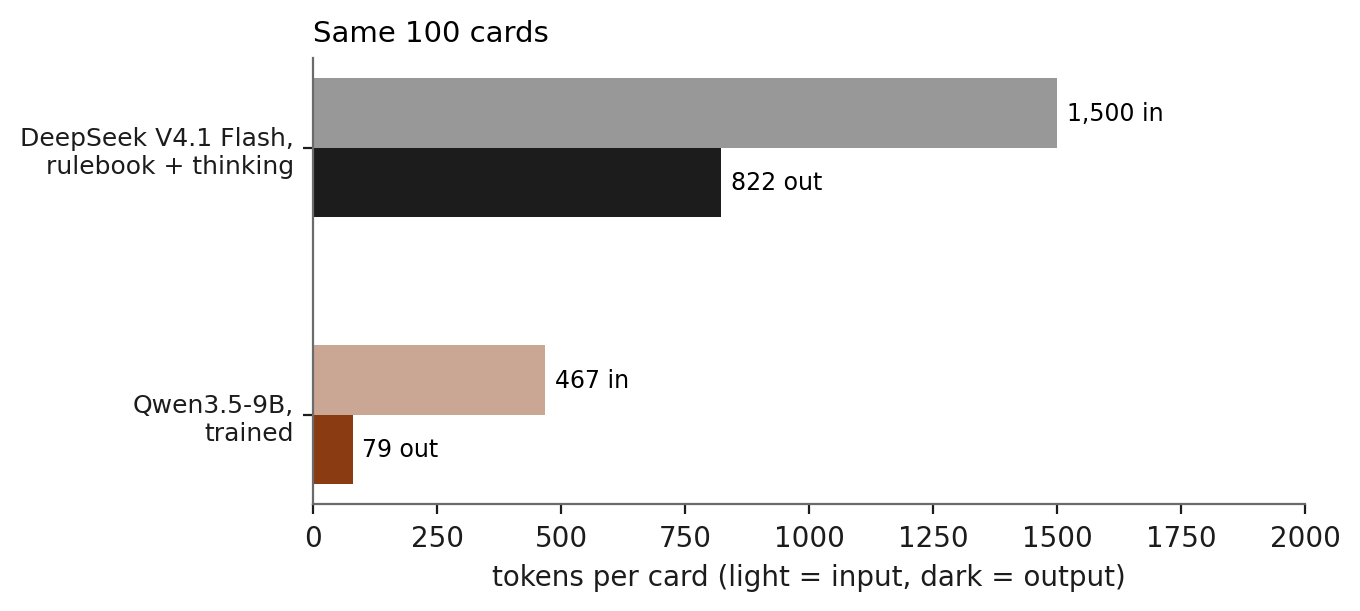
Figure 1. Average input and output tokens per card on the same 100 cards. Counts use each model’s tokenizer and describe those runs; they are not measurements of speed.
The 9B answers in about 80 output tokens from a 467-token input; Flash with the rulebook uses about 1,500 tokens of input and 820 of output per card, most of the output being reasoning. Same reading, at a fraction of the tokens, on a single GPU of your own.
In closing
Why a 9B. From the start, the point of this work has been how to bring AI into this scenario efficiently and at low cost. We tested models from 2B to 35B and chose the 9B for what this position on the line needs. As an exploration, we think it understands the task and makes its calls well, and we also see room to improve it further.
Limitations. For this task we regard the human in the loop as the most important link. The model’s job is to summarise and classify quickly, so that the person using it can take the next step; it does not make legal judgments. Further training may help address the classification weaknesses identified in these experiments.
Looking ahead. In the months we spent on this, AI moved a long way: the open-source side released Qwen3.5, 3.6 and then 3.8, a low-priced API model arrived in DeepSeek V4.1 Flash, and Claude moved from Opus 4.5 to Fable 5.1. We take this to mean that the models available for any one small station will keep getting stronger, which makes a sound design of the agentic workflow around them matter all the more.
Notes
1. Model and data. The trained model is a LoRA adapter for Qwen/Qwen3.5-9B, Apache-2.0, with the prompt and an inference example: ABTdomain/qwen3.5-9b-agent-domain-case-lora. Every real card is taken from a published UDRP decision, from WIPO, the Forum and the other dispute-resolution providers, and is kept with its case number, so each one can be checked against the panel’s own account of the facts. The 9B sees the card, not the decision text. The card format has no WHOIS or registrant contact fields, and the cards shown in this article contain no personal data. The six cloudebot cards are constructed.
2. Running the model. The input is a card of seven fields. The conduct must be recorded actions, specific to one domain; a record that mixes several domains is split first.
domain prefix: <the label left of the TLD, lowercase>
brand: <the mark as registered, uppercase>
brand business: <line of business, or (unknown)>
brand background: <one or two sentences on the owner>
name relation: <identical | contains | similar | typo_like | weak | TBD>
site conduct: <what the record says the site did> || resolves_to: <destination, when the record names one>
flags: parked=<True|False> ppc=<True|False> for_sale=<True|False> phishing=<True|False>

Characterize the use of this domain.
The system prompt. This is v2, the short prompt, about 470 input tokens per card. v1, the rulebook prompt, adds to it the rules that decide each tag; it was given to DeepSeek V4.1 Flash and to the untrained Qwen3.8-27B, roughly 1,500 to 1,800 input tokens per card.
You read one domain case card and characterize how the domain is being used.
Pick exactly one tag:
selling_same_line - the site sells or promotes goods or services in the brand line of business, including parked pages whose links match that line, redirects to competitors, and counterfeit sales made without official claims
parked_sale - a passive parking page with links outside the brand line or links whose content is not recorded, or the domain itself is recorded as offered for sale
impersonation - the site presents itself as the brand owner: official claims, copied official pages or materials, misused official contact identity, pointing at the official site, or recorded fraudulent mail sent in the owner name
traffic_diversion - the domain pushes visitors into unrelated commerce, adult, gambling or dating content, scam or fake warning pages, or malware
blank - no site, an empty or placeholder page, nothing published
own_business - the holder runs a real business or project unrelated to the brand, including criticism sites, fan sites, and personal blogs
Priority when several apply: impersonation > traffic_diversion > selling_same_line > parked_sale > blank.
State only facts that appear on the card. Do not invent content, links, or claims. No apostrophes.
Answer in EXACTLY this format, nothing else:
TAG: <one tag>
SITE: <one sentence, what the site does>
MARK: <one sentence, name relation and business overlap>
SO: <one sentence, the conclusion that follows>
The template: Qwen chat format with the empty thinking block, greedy decoding, at most 128 new tokens; leave one empty line after </think>, as in training.
<|im_start|>system
{system prompt}<|im_end|>
<|im_start|>user
{card}<|im_end|>
<|im_start|>assistant
<think>

</think>
This work ran on MareNostrum 5 at the Barcelona Supercomputing Center under the EuroHPC playground allocation EHPC-AIF-2026PG01-689. Our thanks to EuroHPC JU and BSC. The adapter, with its prompt and an inference example, is on Hugging Face: ABTdomain/qwen3.5-9b-agent-domain-case-lora.
This work uses models from the Qwen3.5 family, developed by the Qwen Team at Alibaba Cloud and released under the Apache 2.0 license. The comparison runs used the DeepSeek V4.1 Flash API.


We acknowledge the European High Performance Computing Joint Undertaking (EuroHPC JU) for awarding this project (EHPC-AIF-2026PG01-689) access to the MareNostrum 5 supercomputer, hosted by Barcelona Supercomputing Center.
Co-funded by the European Union. Views and opinions expressed are those of the authors only and do not necessarily reflect those of the European Union or the European High Performance Computing Joint Undertaking.